
Start with part function, not process preference
When you need a custom plastic component, the first decision is not which machine to use. It is which process can meet the part's functional requirements at an acceptable total cost. Injection molding and thermoforming sit at different points on the volume-complexity spectrum, and choosing the wrong one can lock in unnecessary tooling spend or force design compromises that show up later in assembly.
This guide is for buyers and engineers moving from concept to supplier evaluation. It explains how the two processes differ in practical terms, when each is the better fit, what evidence to request from a supplier, and how to validate a sample before committing to batch production.
How the two processes differ in practice
Injection molding
Injection molding melts plastic pellets and injects the melt into a closed metal mold under pressure. The plastic cools in the mold cavity, the mold opens, and the part is ejected. The process can produce complex three-dimensional geometry, integrated features such as bosses and ribs, and tight repeatability once the mold is qualified.
Tooling is typically a steel or aluminum mold machined to the part geometry. That tool represents a significant upfront investment, and its cost and lead time scale with part size, complexity, and expected production life. Per-part cost falls as volume rises because the tooling cost is spread across more units.
Thermoforming
Thermoforming heats a plastic sheet until it is soft, then forms it over or into a mold using vacuum, pressure, or mechanical force. The formed sheet is cooled and trimmed to final shape. The process is well suited to large, relatively shallow, open shapes such as trays, covers, housings, and panels.
Tooling for thermoforming is generally simpler and less expensive than injection molding tooling because it does not need to withstand high injection pressures. However, thermoformed parts usually cannot match injection molding for fine feature detail, tight dimensional control across complex geometry, or integrated mechanical features without secondary operations.
Decision criteria that matter to buyers
The right process depends on a combination of part geometry, volume, material, tolerance, and program timeline. Use the table below to frame the comparison, then confirm the specific values with your supplier.
| Decision factor | Injection molding | Thermoforming |
|---|---|---|
| Part geometry | Complex 3D shapes, ribs, bosses, snap features, and integrated detail | Open, relatively shallow shapes; deep draws and undercuts need special attention |
| Typical volume fit | Medium to high volumes where tooling cost can be amortized | Low to medium volumes, or large parts where injection tooling would be costly |
| Tooling investment | Higher upfront cost; tool life and maintenance need to be planned | Lower upfront cost; tooling simpler but may wear faster depending on material |
| Dimensional control | Generally tighter and more repeatable across complex features | More variable; shrinkage and sheet thickness variation affect final dimensions |
| Material choice | Broad range of engineering resins, including ABS, PC, PBT, PET, and PA66 | Limited to sheet-form materials that can be heated and formed |
| Surface and color | Color can be compounded into the resin; texture comes from the mold | Surface follows the sheet; color is usually in the sheet or applied after forming |
| Secondary operations | Usually fewer; features can be molded in | Often more; trimming, drilling, and assembly are common |
The table is a starting point, not a verdict. A part that looks like a thermoforming candidate on shape may still need injection molding if it must hold a critical tolerance or survive repeated mechanical loading. Conversely, a large enclosure may be cheaper to thermoform even at moderate volume because the injection mold would be disproportionately expensive.
When injection molding is the better fit
Injection molding earns its tooling cost when the part has to do more than hold a shape. Consider it when:
- The part has integrated mechanical features. Bosses, ribs, snap fits, and mounting points can be molded directly into the part, reducing assembly steps and secondary operations.
- Dimensional repeatability is critical. Mating parts, motor mounts, and assemblies that must fit consistently benefit from the tighter process control of injection molding.
- Volume justifies the tool. The higher the production quantity, the more the per-part cost advantage of injection molding outweighs the upfront tooling investment.
- The material is an engineering resin. Materials such as ABS, PC, PBT, PET, and PA66 are commonly processed by injection molding, and the process allows color and additives to be compounded into the resin.
Motor plastic parts are a typical example. An impeller used in a motor cooling assembly needs blade geometry, balance, and a hub that fits the shaft. Those requirements usually point to injection molding rather than thermoforming.
When thermoforming is the better fit
Thermoforming is often the pragmatic choice for large, simple parts where the tooling budget or timeline rules out injection molding. Consider it when:
- The part is large and relatively shallow. Trays, covers, and panels can be formed from sheet without the cost of a large injection mold.
- Volume is low or uncertain. Lower tooling cost reduces the risk of committing to a design that may change.
- The design is still evolving. Simpler tooling can be revised more easily than a complex injection mold, though this depends on the specific tool and supplier.
- The part does not need fine detail or tight tolerances. If the function is containment, coverage, or protection rather than precision assembly, thermoforming can be sufficient.
Electronic component blister trays are a common thermoforming application: the tray holds components during handling and shipping, and the geometry is relatively open. The same logic applies to simple covers and housings.
Material and design trade-offs to resolve early
Material choice and part design are linked to process selection, and changing one late in the program can force a costly redesign. Resolve these questions before tooling is cut.
Material
Injection molding can process a wide range of thermoplastics, including ABS, PC, PBT, PET, and PA66. Thermoforming is limited to sheet materials that can be heated to a formable state without degrading. If the application requires a specific engineering resin, confirm that it is available in a form suitable for the chosen process.
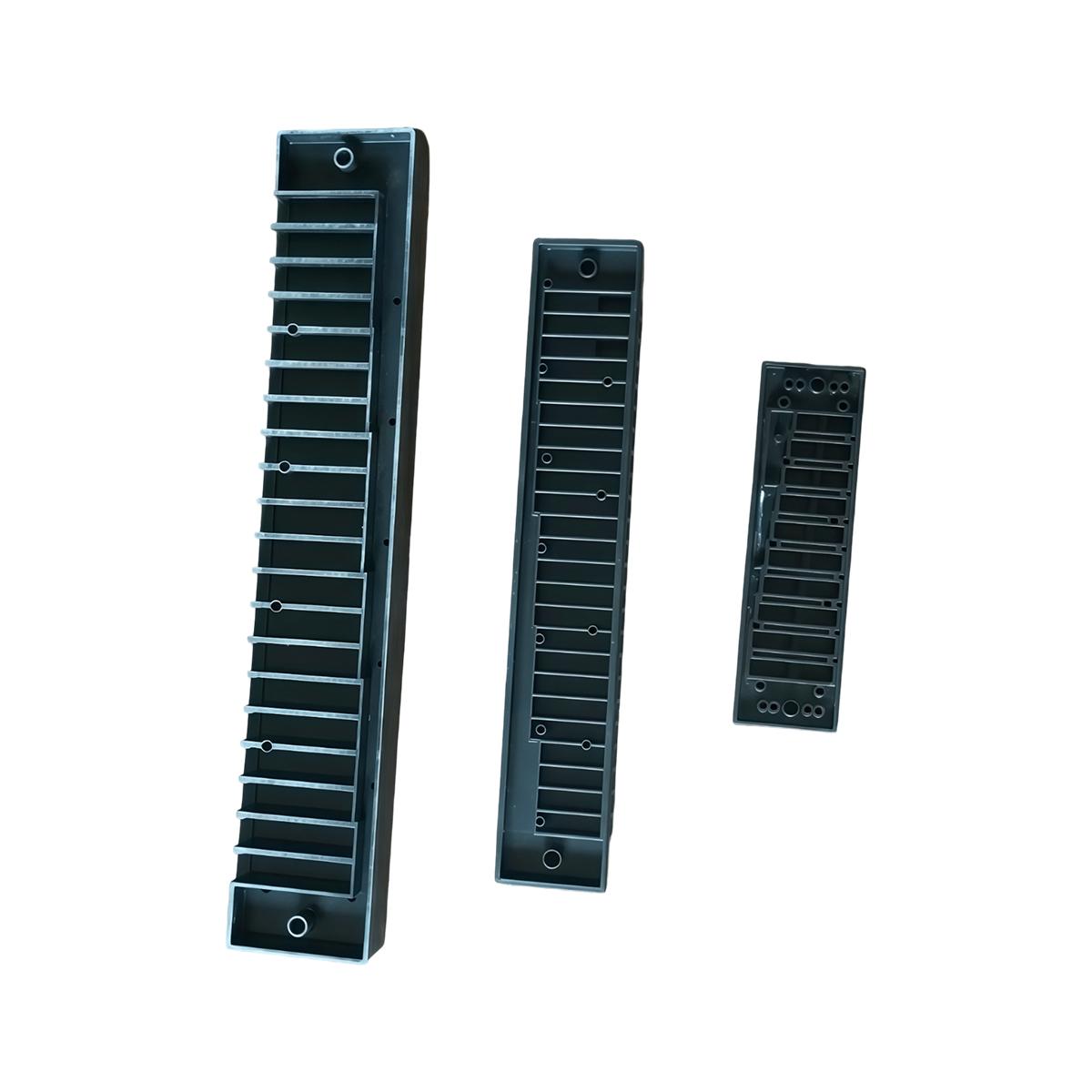
For a harmonica comb, for example, black ABS is a common material choice. The part is small and has detailed air channels, which makes injection molding a natural fit. A thermoformed sheet would struggle to reproduce that internal geometry consistently.
Wall thickness and geometry
Injection molding requires careful wall thickness design to avoid sinks, warpage, and short shots. Thermoforming starts from a sheet of uniform thickness, but the forming process thins the material in deep draws. If the part needs a consistent wall section, injection molding is usually easier to control.
Tolerances
Do not assume a tolerance is achievable because a similar part was made before. Tolerance capability depends on material, geometry, tool condition, and process settings. Ask the supplier to confirm which dimensions are critical and how they will be verified. For a fender component or a motor impeller, the mounting and mating dimensions matter more than cosmetic surfaces.
What to ask a supplier before you commit
The supplier's answers reveal whether they have the process knowledge to catch problems early. Ask these questions in writing and compare responses across candidates.
- Which process do you recommend for this part, and why? A supplier who recommends injection molding for a large shallow tray without discussing tooling cost may not be considering your total cost.
- What tooling is required, and who owns it? Clarify tool ownership, maintenance responsibility, and what happens to the tool if the program ends.
- What is your sample approval process? Ask for a sample confirmation step before batch production, and specify which dimensions and attributes will be measured.
- How do you handle material certification? Request material data sheets and confirm that the resin or sheet grade matches the drawing or specification.
- What production progress feedback can you provide? Agree on reporting frequency and format for the order.
- What is your change control process? If the design changes after tooling, how are costs and timelines handled?
RT-Plasparts, for example, states that drawings or samples can be reviewed for custom production, sample confirmation can be arranged before batch production, and production progress feedback can be provided as agreed for the order. Those are the process commitments to verify in a supplier's quote and quality plan.
Validate with a sample before batch production
A sample is not a formality. It is the point where design assumptions meet manufacturing reality. Use the sample stage to check:
- Critical dimensions against the drawing, using a measurement plan agreed in advance.
- Material and color against the specification, including supplied-part color such as black or natural.
- Fit and function in the intended assembly, especially for mating parts like impellers, combs, and fender components.
- Cosmetic acceptance against a written standard, not a verbal impression.
If the sample fails, document the deviation and agree on corrective action before approving batch production. A supplier who resists a formal sample approval step is a warning sign.
Warning signs in supplier evaluation
Most sourcing problems are visible before the purchase order if you know what to look for. Treat these as reasons to ask harder questions:
- The supplier quotes a process without asking about part function, volume, or tolerance requirements.
- Tooling cost and ownership are vague, or the tool is described only as "customer's" without documentation.
- Material grade is not specified, or the supplier cannot provide a data sheet for the exact grade.
- Sample approval is skipped or compressed into a verbal confirmation.
- Production progress reporting is promised but not defined in frequency or format.
- The supplier claims capability for both processes but cannot explain when each is appropriate.
Next steps for your sourcing decision
Write a one-page requirement summary before contacting suppliers. Include the part's function, annual volume estimate, critical dimensions and tolerances, material and color, cosmetic requirements, and target timeline. Send the same summary to every candidate so their responses are comparable.
Then ask each supplier to recommend a process and justify it against your requirements. Compare not only price but tooling ownership, sample approval process, material documentation, and progress reporting. The supplier who gives you a clear, specific rationale is easier to hold accountable than one who simply quotes a number.